IMPACT STORIES
WEAVING THE FUTURE OF CONNECTIVITY IN SOUTHERN PUNJAB: THE MUZAFFARGARH OPTICAL FIBER PROJECT
27th January, 2026
1. Introduction: The Challenge of the Digital Divide
The Universal Service Fund (USF), operating under the leadership of the Ministry of Information Technology and Telecommunication (MoITT), continues to play a pivotal role in advancing the goals of the Prime Minister of Pakistan’s Digital Pakistan Vision, a national agenda aimed at transforming Pakistan into a digitally empowered economy through enhanced connectivity, innovation, and inclusion.
Access to reliable, high-speed broadband is fundamental to economic growth, education, healthcare, and governance. However, many rural and remote regions remain digitally underserved due to limited commercial viability for private investment. This is precisely the gap the USF was established to bridge. By levying contributions from telecom operators, USF finances and subsidizes projects that extend connectivity to unserved and underserved rural communities across the country. The USF’s Next Generation Optical Fiber Network & Services (NG-OFNS) program is a cornerstone of this strategy, focusing on deploying high-capacity optical fiber networks that serve as the digital highways for all current and future telecommunication services.
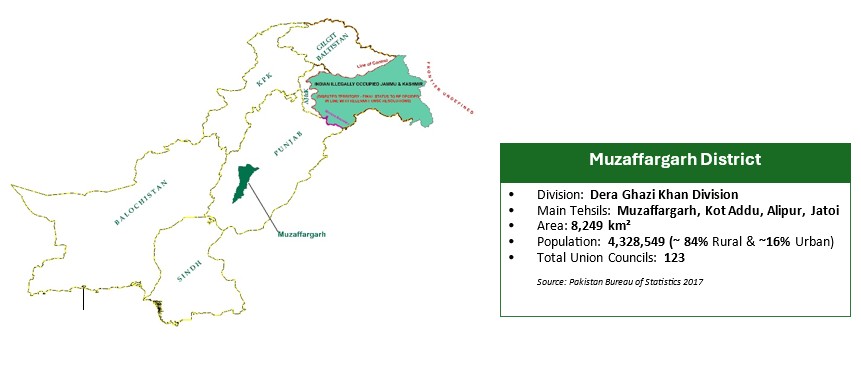
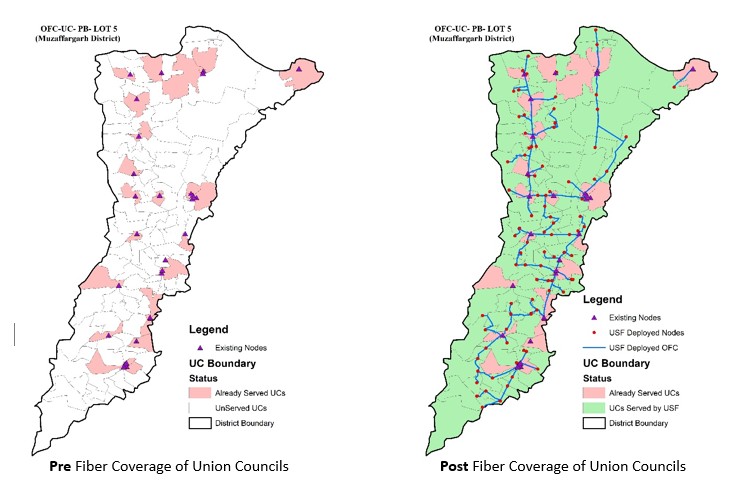
A tangible manifestation of this national ambition is the NG-OFNS project (OFC-UC-PB-Lot 05) in the Muzaffargarh district. This initiative aims to integrate four tehsils—Muzaffargarh, Kot Adu, Alipur, and Jatoi—into the national digital grid by extending an optical fiber network to 91 unserved Union Councils (UCs) out of a total of 123 in the district. Here, unserved refers to UCs that previously lacked optical fiber connectivity. The primary objective is to establish robust backhaul infrastructure, creating a digital backbone to support mobile network operators, government offices, educational institutions, health centers, financial institutions, and ultimately, the residents of the district.
Geographically, Muzaffargarh district forms a long strip between the Indus and Chenab rivers in the Dera Ghazi Khan Division of southwestern Punjab, a region now set to reap the benefits of high-speed connectivity as part of the Digital Pakistan revolution.
2. The Public-Private Partnership Model
The success of the Muzaffargarh project is rooted in its transparent and competitive execution model, which effectively leveraged the strengths of both the public and private sectors.
2.1 A Transparent Bidding and Award Process
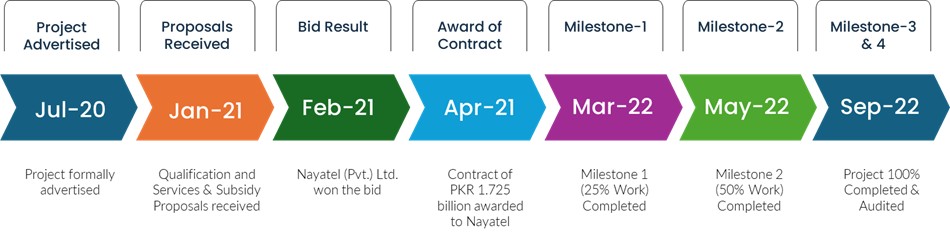
The project was formally advertised on July 12, 2020, generating interest from five leading telecom service providers. By January 15, 2021, Qualification and Services & Subsidy Proposals were received and subjected to a comprehensive and transparent evaluation process in accordance with USF’s rules. After rigorous technical and financial scrutiny, Nayatel (Pvt.) Ltd. emerged as the lowest evaluated qualified bidder on February 3, 2021. Subsequently, a contract valued at PKR 1.725 billion was awarded to Nayatel on April 9, 2021, marking the successful conclusion of a fair, competitive, and transparent bidding process.
2.2 Building a Future-Proof Network
The USF’s technical specifications for the project were stringent and forward-looking, ensuring that the deployed infrastructure would not only meet immediate needs but also serve the region for decades to come. Key specifications included:
- High-Capacity Cable: A minimum of 48-fiber (24-pair) cable for all routes to support multiple services simultaneously.
- Scalable Network Nodes: All network nodes to support a minimum backhaul of 10 Gbps, with a clear upgrade path to 100 Gbps, and a minimum switching capacity of 100 Gbps.
- Last-Mile Readiness: Each node equipped to provide optical access services (like GPON) to a minimum of 128 users, anticipating the future demand for direct fiber-to-the-home connections.
The project was executed with remarkable efficiency, achieving its four major milestones for technical audit and completion between March 2022 and September 2022.
|
OFC Deployed |
Fiber Connected Union Councils |
Fiber Enabled Population |
|
699 Km |
91 |
2,486,000+ |
3. The Ripple Effect: Seeding a Sustainable Digital Ecosystem
The true success of a subsidy-based project is measured by its impact. In Muzaffargarh, the initial USF investment has acted as a powerful catalyst, sparking a wave of subsequent commercial investment and expansion by the Service Provider (Nayatel Pvt Ltd). This demonstrates the project's long-term viability and transformative impact.
3.1 From Backhaul to Broadband Homes
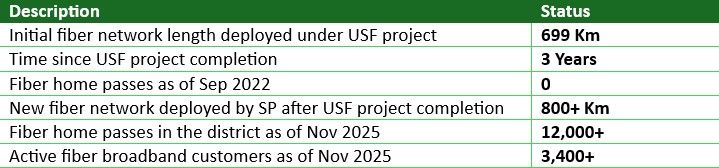
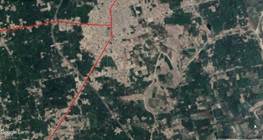
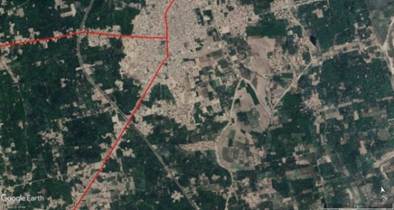
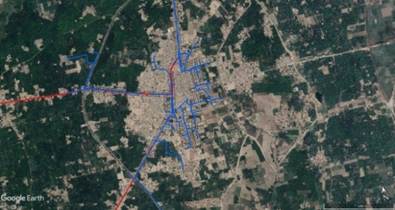
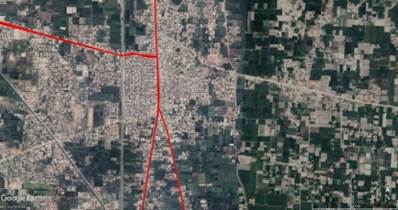
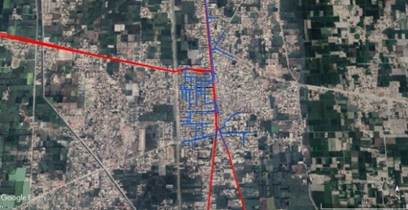
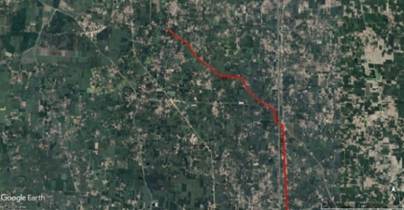
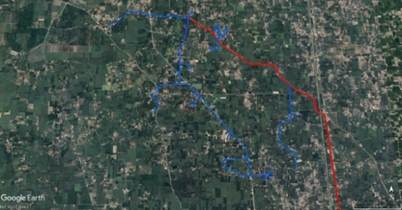
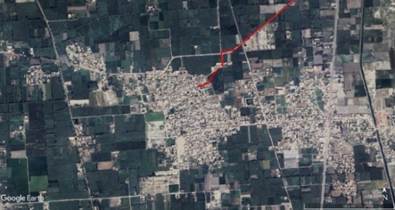
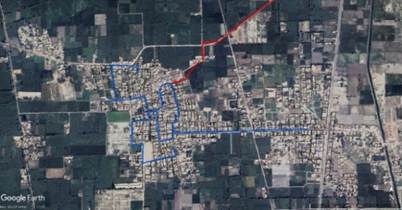
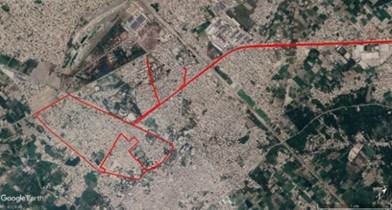
While the original project scope focused on building the core optical fiber network connecting all UCs, the Service Provider (SP) immediately recognized the commercial potential it unlocked. In the three years since the project's completion, the SP has undertaken a substantial, self-funded expansion, as detailed below:
|
Network at USF-Project Completion |
Post-USF-Project Network Extension |
|
UC Khangarh: |
|
|
|
|
|
USF Funded Fiber Deployment – 9 Km |
Service Provider Extension Network – 32+ Km |
|
UC Sanawan: |
|
|
|
|
|
USF Funded Fiber Deployment – 37 Km |
Service Provider Extension Network – 27+ Km |
|
UC Sheikh Umar & UC Pirhar: |
|
|
|
|
|
USF Funded Fiber Deployment – 5 Km |
Service Provider Extension Network – 35+ Km |
|
UC Thatha Gurmani: |
|
|
|
|
|
USF Funded Fiber Deployment – 12 Km |
Service Provider Extension Network – 15+ Km |
|
Muzaffargarh City: |
|
|
|
|
|
Initial Fiber Deployment – 22 Km |
Service Provider Extension Network – 120+ Km |
3.2 Empowering the Broader Telecom Ecosystem
The NG-OFNS network is a shared asset that benefits the entire digital ecosystem. The SP has already connected 11 cellular BTS towers to this fiber backhaul, enabling mobile operators to improve their 3G/4G services and prepare for 5G. Furthermore, 249 km of the network's dark fiber has been leased to other entities, creating a new revenue stream and validating the network's value to other service providers.
3.3 Strengthening Enterprise Connectivity
The SP has also extended the optical fiber network to key corporate and institutional customers, including Daanish Schools, Indus Textile, TATA Textile, Mahmood Group, Pak-Arab Refinery Ltd. (PARCO), Attock Refinery Ltd., Faisal Movers, and Daewoo Express etc. This growing enterprise uptake underscores the network's reliability and its expanding role in supporting regional business and institutional operations.
3.4 Employment Impact
The project directly created 150+ jobs for engineers, technicians, and skilled labour, while also generating indirect employment in logistics, supply chains, retail, and services, boosting the region’s skilled workforce and socio-economic development.
4. Future Outlook
The Muzaffargarh NG-OFNS project is more than just another rural connectivity initiative; it symbolizes a foundational step towards Pakistan's digital future.
- 5G Readiness: The deployment of 5G technology is critically dependent on the availability of deep, high-capacity fiber networks. The 10 Gbps-to-100 Gbps capable backhaul built in this project is precisely the infrastructure required to support the data-intensive demands of 5G base stations. By connecting rural BTS towers, this project is already making the region 5G-ready.
- A Commitment to Continued Growth: The project's success has created a self-sustaining cycle of investment. The SP has committed to adding 1,000 new fiber home passes every year for the next five years, ensuring that the benefits of connectivity continue to spread throughout the district.
5. The Essence of Success
The USF optical fiber project in Muzaffargarh stands as an unequivocal success. It showcases how a well-structured public-private partnership can bridge long-neglected market gaps, spark significant commercial investment, and deliver meaningful connectivity to rural communities. By linking 91 UCs with optical fiber, the project has accelerated broadband growth, strengthened the backbone for future 5G, and energized a vibrant digital ecosystem. More than an infrastructure upgrade, it offers a scalable blueprint for the Government of Pakistan’s vision for Digital Pakistan—driving inclusive development and transforming regional socio-economic potential.